...it's still no fun. My primary computer, a Windows machine, is showing blue screen. I'm not 100% certain yet, but I think the hardware is ok. I believe I'm having problems with ntfs.sys. My problem is that I can't find a way to boot the computer--no matter what changes I make to the setup, I can't get it to boot from a live CD in the CD-ROM drive.
Alas, this will occupy my free time for the foreseeable future and will impact my posting frequency.
Wish me luck.
Tuesday, October 30, 2007


Thursday, October 25, 2007
Highway hypnosis...time for a vacation?
I had an occurrence a few days ago while commuting to work on my motorcycle: highway hypnosis or automaticity. I recall catching a green light on a heavily traveled highway on my way to work and then had the sensation of "waking up" some 8 miles further down the road. I cannot recall passing any of the intervening landmarks or any other details like the amount of traffic on the road--which, no doubt, was heavy as I was in the midst of the morning rush hour. After this happened, it seemed right to find a spot to pull off and take a few deep breaths.
You may have had such an experience. While driving you suddenly realize you cannot recall the last several minutes on the road, or you may not remember anything after passing some point. I have had this experience in automobiles several times but never before while riding.
This experience is scary enough on four wheels, but is downright chilling when on two. Riding a motorcycle requires constant alertness and it's best to assume every car you can see is trying to run you over (click for my Tips on Riding post). Regularly, I have to dodge autos driven by myopic drivers that cross my path intentionally or by mistake. This requires vigilance paying attention to cars and circumstances trying to anticipate the possibilities of close encounters. It is difficult to imagine doing this successfully when zoned out in some hypnotic state. Riding on two wheels, even driving on four, is no place to be on autopilot.
Despite riding several times since this event, without zoning out I might add, I've decided I need a vacation.
Friday, October 19, 2007
Getting Experience Riding Your Motorcycle
Ride.
Ride on straight roads.
Ride on twisty roads.
Ride slow.
Ride fast.
Put miles on your bike.
The best way to get experience riding a motorcycle is to ride a motorcycle.
But don't ride beyond your comfort zone. Initially, stay on familiar roads at moderate speeds until your are throughly accustomed to your motorcycle. My advice is to ride alone, vice riding in a group with other motorcyclists, at least initially. Do this until you have achieved a level of familiarity where you don't have to be conscious about shifting, braking, or any of the other mechanics of riding. When riding in a group, many riders and especially new ones, feel peer pressure to "keep up" with other, more experienced riders. Keeping up can tempt new riders to ride beyond their capabilities and possibly make a mistake. Avoid this. Ride alone until you've gained experience.
As you gain experience, concentrate on several aspects of riding:
Check out these books on motorcycle riding from Amazon.com
Ride on straight roads.
Ride on twisty roads.
Ride slow.
Ride fast.
Put miles on your bike.
The best way to get experience riding a motorcycle is to ride a motorcycle.
But don't ride beyond your comfort zone. Initially, stay on familiar roads at moderate speeds until your are throughly accustomed to your motorcycle. My advice is to ride alone, vice riding in a group with other motorcyclists, at least initially. Do this until you have achieved a level of familiarity where you don't have to be conscious about shifting, braking, or any of the other mechanics of riding. When riding in a group, many riders and especially new ones, feel peer pressure to "keep up" with other, more experienced riders. Keeping up can tempt new riders to ride beyond their capabilities and possibly make a mistake. Avoid this. Ride alone until you've gained experience.
As you gain experience, concentrate on several aspects of riding:
- Be smooth.
Concentrate on clutch, shift, and throttle so that each up shift is so smooth that the only way you can tell you've shifted gears is aurally. You won't do this every time, and it's nearly impossible when you're accelerating briskly. But when you're not in a hurry and out of traffic where you can concentrate on your riding skills, be smooth. - Exercise throttle control.
Related to the above, consciously practice opening and closing the throttle in controlled, smooth, movements. Avoid snapping the throttle open. Avoid slamming the throttle closed. - Be balanced.
God's laws of physics ensures neophyte riders can keep a motorcycle upright at speed. The gyroscopic effects of the rotating tires provides stability at speed. An easy way to differentiate new riders from experienced is to watch them start off from a stop light. An experience rider has both feet on the pegs nearly as soon as the bike begins to move. A new rider will "walk" his bike with both feet for several yards before putting them on the pegs. The next time you're at a stop light, watch a motorcyclist and determine whether he is a new or experienced rider.
Check out these books on motorcycle riding from Amazon.com
Tuesday, October 16, 2007
How to be a Good Motorcycle Passenger
Riding as a passenger on a motorcycle can be thrilling and enjoyable. To ensure you aren't a hindrance to the rider, there are a few rules to keep in mind. These rules are important. As passenger, you don't want to be the reason the two of you go down. Here they are in order of precedence:
Leaning with the rider in turns is the next most important rule. Not leaning with the rider can severely effect the dynamics of a single track vehicle in a turn--enough to possibly cause the rider to lose control and you both go down.
How much to lean? I've read heard advice like keeping your inside shoulder (left shoulder for left turns, right shoulder for right turns) aligned with the rider's outside shoulder. Effectively, you as passenger will have your head looking over the rider's right shoulder when leaning left and vice versa.
In my opinion, this can be a bit confusing. Very simply: lean with the rider. Don't lean further, don't lean less.
Rule 5 is a variant of Rule 3. Always let the rider know if you need to move around on the bike. Small movements are fine, but if you need to shift your seating or stretch your arms, tap the rider first.
There's no lack of information on how to ride as a motorcycle passenger. Consider this blog entry to be a bare minimum (but it's enough). Check out other links with much more detailed information.
Here's three:
Click for a Google search to find more helpful advice.
A tip: Make sure the rider is ready before mounting or dismounting. Unexpectedly having your weight on one side of the motorcycle can easily cause it to fall over. The rider is likely never to ask you to ride again :(
A last bit of advice: don't ride as a passenger with a newbie rider. Neither of you will have any fun.
- Never take your feet off the foot pegs.
- Never take your feet off the foot pegs.
- See 2.
- Lean with the rider in turns.
- Minimize body movements.
Leaning with the rider in turns is the next most important rule. Not leaning with the rider can severely effect the dynamics of a single track vehicle in a turn--enough to possibly cause the rider to lose control and you both go down.
How much to lean? I've read heard advice like keeping your inside shoulder (left shoulder for left turns, right shoulder for right turns) aligned with the rider's outside shoulder. Effectively, you as passenger will have your head looking over the rider's right shoulder when leaning left and vice versa.
In my opinion, this can be a bit confusing. Very simply: lean with the rider. Don't lean further, don't lean less.
Rule 5 is a variant of Rule 3. Always let the rider know if you need to move around on the bike. Small movements are fine, but if you need to shift your seating or stretch your arms, tap the rider first.
There's no lack of information on how to ride as a motorcycle passenger. Consider this blog entry to be a bare minimum (but it's enough). Check out other links with much more detailed information.
Here's three:
Click for a Google search to find more helpful advice.
A tip: Make sure the rider is ready before mounting or dismounting. Unexpectedly having your weight on one side of the motorcycle can easily cause it to fall over. The rider is likely never to ask you to ride again :(
A last bit of advice: don't ride as a passenger with a newbie rider. Neither of you will have any fun.
Monday, October 15, 2007
Learning to Ride
The mechanics of riding a motorcycle is like doing most things: at first new and possibly intimidating, but eventually routine and accomplished unconsciously. This is a short essay on the mechanics--the how to do it--of riding a motorcycle based on several decades of experience encompassing all aspects of street riding including commuting in high density metropolitan areas to road trips on infrequently used rural back roads. I also refer you to my riding tips blog entry that you might find interesting.
Step 1 - Learn to ride a bicycle.
If you don't know how to ride a bicycle, starting with a motorcycle is not recommended. Learn to ride a bike. Balance and turning on a single track vehicle is the same regardless of whether it is engine powered or pedal powered.
Step 2 - Motorcycle controls.
The hand and foot controls are the same for all motorcycles built since 1975. Count this as an advantage. Some older motorcycles, especially those from Britain, had the gear shift location and shift pattern opposite than other bikes and keeping mental track of this was, at least for me, a herculean task.
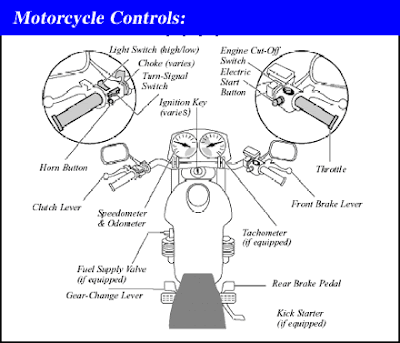
The sketch above can, at first, appear busy and therefore intimidating. So, let's focus on those controls associated with riding and leave the others for later.
Specifically, the hand and foot controls:
An aside:
Operating a clutch.
Knowing how a clutch works will greatly facilitate your learning to ride a motorcycle if you don't already have experience driving a car with a manual transmission. If you know how to use a manual transmission, skip down.
Sequential shifting.
(The following description is correct for almost all motorcycles. The most common exception will be motorcycles with 4 or 6 speed transmissions.)
Motorcycle transmissions use sequential shifting operated by the left foot. The shift pattern is "1 down, 4 up". This means first gear is engaged by pressing the shift lever down with your toe. Second is engaged by placing your toe under the lever and lifting up. Lift up again for third. Fourth and fifth gear are done the same way.
To down shift, do the opposite: Press the shift lever down with your toe to go from 5th to 4th, press again to 3rd, again to 2nd, and once more for 1st.
Neutral is located "half-way" between first and second. This can be confusing at first and some bikes are particularly difficult to find neutral requiring rocking back and forth at a stop or shifting to neutral before stopping--you'll learn the idiosyncrasies of finding neutral on your bike soon enough.
Step 3 - Riding.
Ride with your motorcycle-owning friend to an open parking lot. Stop the bike in a clear area and shut it off. Convince your friend to let you sit on the bike. Put both hands on the handle bars, leave the bike on its kick stand, and put both feet on the foot pegs. (Yes, you'll be leaning to the left.) Pull in on the clutch lever with your left hand. Do this several times to get the feel of engaging and disengaging the clutch.
If it feels like only Arnold Schwarzenegger can operate the clutch, then you're on the wrong bike. Find another motorcycle-owning friend and start over with this step.
You can try putting the bike in gear with your left foot, but this is uneventful unless the bike is running. So, give the owner $2 and ask him to buy a soda at 7-Eleven. After out of sight, pull the bike up and raise the kick stand, turn the key, press the starter button, and blip the throttle (biker speak for 'turn quickly') no more than about 1/8th of a turn. Blipping the throttle doesn't help you put it in gear, but it sounds cool.
Pull in the clutch, support the bike by leaning a bit on your right foot, raise your left foot to the foot peg and press the gear shift lever down into first. You'll feel the bike lurch and hear it "clunk." Put both feet on the ground. Slowly (s-l-o-w-l-y) let the clutch lever out (disengage the clutch) until you feel the bike just beginning to move. Pull the clutch back in (engage the clutch). Do this several times until you can anticipate, based on the clutch lever position, when it just begins to engage.
With both feet on the ground, slowly let the clutch out. Just before the clutch begins to engage, twist the throttle slowly and no more than about 1/8 of a turn just as you did when you were looking cool. Continue to engage (let out) the clutch as you turn the throttle keeping your feet out as "out riggers." Never letting go of the clutch lever, let the bike inch forward a foot or so and pull the clutch back in completely and gently squeeze the front brake (right lever) until the bike stops.
After doing this several times, stop the bike, turn the key to off. Extend the kick stand and carefully lower the bike on it. Dismount the bike and give yourself a hand. You just rode a motorcycle.
Step 4 - Practice.
Repeat step 3 until you are moving further and fast enough to confidently raise both feet to the foot pegs. Do not try to do too much too soon. Several small successes are more important than a large one.
Do not ride on the street until you are completely comfortable and confident. Riding on the street requires complete concentration on road conditions and safety, your focus should be on these things and not the mechanics of riding. You want to be able to confidently ride the bike in the parking lot shifting the gears both up and down, braking, and turning. Only after mastering these steps are you ready for the street.
Step 1 - Learn to ride a bicycle.
If you don't know how to ride a bicycle, starting with a motorcycle is not recommended. Learn to ride a bike. Balance and turning on a single track vehicle is the same regardless of whether it is engine powered or pedal powered.
Step 2 - Motorcycle controls.
The hand and foot controls are the same for all motorcycles built since 1975. Count this as an advantage. Some older motorcycles, especially those from Britain, had the gear shift location and shift pattern opposite than other bikes and keeping mental track of this was, at least for me, a herculean task.
The sketch above can, at first, appear busy and therefore intimidating. So, let's focus on those controls associated with riding and leave the others for later.
Specifically, the hand and foot controls:
- left hand lever operates the clutch
- left foot lever shifts gears
- right hand lever operates the front brake
- right foot lever operates the rear brake
- right hand grip operates the (twist) throttle
An aside:
Operating a clutch.
Knowing how a clutch works will greatly facilitate your learning to ride a motorcycle if you don't already have experience driving a car with a manual transmission. If you know how to use a manual transmission, skip down.
Sequential shifting.
(The following description is correct for almost all motorcycles. The most common exception will be motorcycles with 4 or 6 speed transmissions.)
Motorcycle transmissions use sequential shifting operated by the left foot. The shift pattern is "1 down, 4 up". This means first gear is engaged by pressing the shift lever down with your toe. Second is engaged by placing your toe under the lever and lifting up. Lift up again for third. Fourth and fifth gear are done the same way.
To down shift, do the opposite: Press the shift lever down with your toe to go from 5th to 4th, press again to 3rd, again to 2nd, and once more for 1st.
Neutral is located "half-way" between first and second. This can be confusing at first and some bikes are particularly difficult to find neutral requiring rocking back and forth at a stop or shifting to neutral before stopping--you'll learn the idiosyncrasies of finding neutral on your bike soon enough.
Step 3 - Riding.
Ride with your motorcycle-owning friend to an open parking lot. Stop the bike in a clear area and shut it off. Convince your friend to let you sit on the bike. Put both hands on the handle bars, leave the bike on its kick stand, and put both feet on the foot pegs. (Yes, you'll be leaning to the left.) Pull in on the clutch lever with your left hand. Do this several times to get the feel of engaging and disengaging the clutch.
If it feels like only Arnold Schwarzenegger can operate the clutch, then you're on the wrong bike. Find another motorcycle-owning friend and start over with this step.
You can try putting the bike in gear with your left foot, but this is uneventful unless the bike is running. So, give the owner $2 and ask him to buy a soda at 7-Eleven. After out of sight, pull the bike up and raise the kick stand, turn the key, press the starter button, and blip the throttle (biker speak for 'turn quickly') no more than about 1/8th of a turn. Blipping the throttle doesn't help you put it in gear, but it sounds cool.
Pull in the clutch, support the bike by leaning a bit on your right foot, raise your left foot to the foot peg and press the gear shift lever down into first. You'll feel the bike lurch and hear it "clunk." Put both feet on the ground. Slowly (s-l-o-w-l-y) let the clutch lever out (disengage the clutch) until you feel the bike just beginning to move. Pull the clutch back in (engage the clutch). Do this several times until you can anticipate, based on the clutch lever position, when it just begins to engage.
With both feet on the ground, slowly let the clutch out. Just before the clutch begins to engage, twist the throttle slowly and no more than about 1/8 of a turn just as you did when you were looking cool. Continue to engage (let out) the clutch as you turn the throttle keeping your feet out as "out riggers." Never letting go of the clutch lever, let the bike inch forward a foot or so and pull the clutch back in completely and gently squeeze the front brake (right lever) until the bike stops.
After doing this several times, stop the bike, turn the key to off. Extend the kick stand and carefully lower the bike on it. Dismount the bike and give yourself a hand. You just rode a motorcycle.
Step 4 - Practice.
Repeat step 3 until you are moving further and fast enough to confidently raise both feet to the foot pegs. Do not try to do too much too soon. Several small successes are more important than a large one.
Do not ride on the street until you are completely comfortable and confident. Riding on the street requires complete concentration on road conditions and safety, your focus should be on these things and not the mechanics of riding. You want to be able to confidently ride the bike in the parking lot shifting the gears both up and down, braking, and turning. Only after mastering these steps are you ready for the street.
Monday, October 8, 2007
Oct 2007 Ride to the Flight 93 Memorial

In early October, my wife and I, along with two of our closest friends, made plans to visit the Flight 93 Memorial Site in Shanksville, PA. We planned to leave Friday heading northwest to Cumberland, MD to stay the evening and then north to the Memorial Site on Saturday. Afterwards, we would head back home planning to get in by early evening on Saturday.
We had hoped to be on the road by 3pm, which even at a leisurely pace, would have got us to the hotel before 7pm. Unfortunately, we were not able to leave until closer to 5pm and rode about half of the way in the dark. Despite this, the ride was nice as the weather was unseasonably warm and we were able to escape the traffic once off of Rte 50. As we rode up and over the Blue Ridge, we had to keep a keen eye for deer and saw many on the way. We rolled into the Best Western in LaVale at around 9pm.

The route to the hotel.
View Larger Map

The next morning we woke to an overcast sky that was a bit cool and damp. But the previous week told us this would burn away to sunshine with hot and humid temps--and it did.
We made a short excursion west to see the partially built Noah's Ark just south of Frostburg, MD. (I took particular notice of the fact that steel I-beams are being used to frame the Ark...something I'm pretty sure Noah didn't do.) From there we went due north to Shanksville.
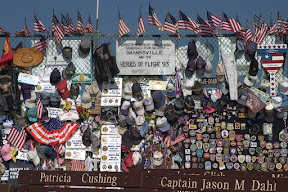
It's difficult not to be emotional at the Memorial Site thinking about the bravery of the passengers and crew of Flight 93. The site is touching in its simplicity and worth a trip to see.

The route from the hotel to the Flight 93 Memorial.
View Larger Map
We originally intended to see some of the off beat, unusual sights in PA (Tiny World, Shoe House, and a reconstruction of the Temple and Ark of the Covenant), but decided instead to stop at a covered bridge we passed while on the way to the Memorial Site.

Memorial Site to covered bridge.
View Larger Map
From the bridge, we opted to head back by first going away from home to the northwest on Rte 30 and then turning south past Frank Lloyd Wright's Fallingwater ultimately back to Rte 50 before we turned east for home. This had us going back across the mountains later than intended. To expedite getting home, we opted to take the interstate from Winchester making a high speed run in the dark. By the time we got in, we had been on the road for 12 hours.
Covered bridge to home...sorta.
View Larger Map
The three ladies were tough, sticking it out for the full day still with smiles and no complaints. My wife wrestled her trike up and down mountains with aplomb (twisty roads require significantly more physical strength on 3 wheels than on 2). Better riding companions don't exist.
We logged the following stats on this trip:
- Total miles: 490
- Average speed: 32 mph
- Moving average: 43 mph
- Max speed: 85 mph (whoops!)
Sunday, September 30, 2007
2007 Trip to Oz
My wife and I with our riding companion took a 13 day trip from home to the Ozarks in Missouri. We planned to take 3 days to travel the 1000-miles from home to West Plains, MO maximizing the time spent on secondary roads. We traveled about 300 to 350 miles each day stopping for 15-min each hour. This pace, combined with generally dry weather and moderate temperatures made for a very easy ride there and back.
While there, we spent 7 days riding the roads in the Ozarks. A beautiful combination of good weather, winding roads, minimal auto traffic, and a general lack of local constabulary made for a perfect vacation.
Here's a map showing the local Oz riding we did for a week. Note, several tracks were ridden numerous times as we stopped to visit family, eat meals, and sight see.

Here's a Picasa (Google) Web album of the photos geo-coded to a map. Check it out.
 |
| Trip to Oz |
Thursday, September 27, 2007
More details please
I've been asked to provide more details about the posted rides. Ok. I'll do my best to record details about the road, weather, places, people, and anything else of note.
Posts on rides already taken will continue to be succinct and are unlikely to include many details beyond the route (using Google Maps) and some photos. For some rides I'll include GPS data (lat, lon) for points of interest.
Thanks!
John the Rider Guy
Posts on rides already taken will continue to be succinct and are unlikely to include many details beyond the route (using Google Maps) and some photos. For some rides I'll include GPS data (lat, lon) for points of interest.
Thanks!
John the Rider Guy
Saturday, September 22, 2007
August 2005 Ride to Atlantic City
In August 2005, my wife rode her 2001 Goldwing Trike from home to Atlantic City with me as passenger. I forgot to record the mileage, but it was on the order of 500-miles. We combined some Interstate roads with byways; not having too many options when heading north from the Washington DC area and trying to make time due to a late day start. In any case, we had fun staying at the Sands Casino Hotel in Atlantic City and returned via the ferry from Delaware to Maryland. We spent two nights and three days on this trip. Check out the map below.
Here's some photos:

Arriving in Atlantic City at the Sands Casino Hotel.

This is one of the water towers south of Atlantic City. Nice.

Waiting for the Cape May-Lewes Ferry. What was it like when there were no cell phones?

On the Ferry pulling away from Cape May, Delaware.

The trike.

Anywhere, anytime, any how...my wife finds a way to make friends. Here's a couple of wild ones anxious to disembark the Ferry.
View Larger Map
9 Riding Tips
According to various sources including the National Highway Traffic Safety Administration (NHTSA), the typical motorcyclist rides less than 2000 miles per year--other sources indicate much less. Thus, most motorcyclists don't ride enough to develop good riding skills much less good riding-safety awareness.
Up until two years ago, I averaged more than 18,000 miles/year and in the last two my riding is down to 15,000 miles/year--so even using the low figure, I ride about 7 times more than most riders. So, what follows are 9 tips I've picked up that have helped me stay safe even when riding in the non-motorcycle friendly Washington DC metro area. I provide them here in the hopes that some of you may find them useful. If you're thinking of buying a motorcycle, please include these tips with the other safety information you're gathering.
In my priority order of importance:
- Take the Motorcycle Safety Foundation beginner's skills course.
- Assume every car you can see is trying to run you over. Not that they could run you over, or that they might run you over, but that they're trying to run you over. Never forget that even the smallest car is more than a 1000lbs heavier than the largest motorcycle. The laws of physics do not favor the motorcyclist in any sort of car / motorcycle encounter.
- Ride with your high-beam on during the day. The intent is to be seen. Riding with your headlight high beam on may irritate some drivers, but at least they see you!
- Say to yourself, "Just ride the bike." Modern motorcycles with good tires can be leaned at heart-stopping angles without falling. If you find yourself in the middle of a sweeping turn going a little too fast for comfort, don't panic. Just ride the bike. In almost every case, you'll make it through fine. Trust me.
- Your front brake is your friend. You should use both front and rear brakes for every stop. However, many seasoned riders use only the front brake in most non-panic situations. A bike's front brake, just as with cars, provides more than 75% of the braking power. New riders are sometimes reluctant to use the front brake probably because they falsely believe they'll flip over the handlebars. This probably stems from previous experiences on bicycles. To go over the front bars using only the front brake requires a concerted effort. Unlike on a bicycle, the center of mass for a motorcycle and rider is relatively low. Physics is on your side here. If you're not in the habit of using your front brake, you're like to have a close encounter of the unwanted kind.
- Acceleration is your friend. Even small-engined anemic bikes will out accelerate all but the most potent cars. Use this to your advantage. In some cases, it may be easier to avoid a dangerous situation by speeding up and getting out of the way rather than slowing down and hoping the "problem" passes you by.
- Be conscious of lane position.
- Never get between a car and an exit ramp.
- If you're a beginner, don't ride in the rain. With good tires, you can ride almost as fast, lean almost as far, and brake almost as hard in the rain as on dry pavement. If you have rain gear, even getting wet can be minimized to a minor inconvenience. So, what's the big deal with riding in the rain? Visibility--or lack thereof. A driver's ability to see you, and just as important, your ability to see them, can be severely diminished in the rain. As a test, turn your windshield wipers off in your car the next time it's raining and you'll see how hard it is to see.
For the price of the course (a good investment IMHO), you get to ride someone else's bike (so don't worry about dropping it!) and learn a good deal about what it takes to ride safely on the street. Despite what you might hear, this is not a motorcycle familiarization class--if you don't know how to ride, don't assume you'll learn from this class. It's best to know riding basics before you take the class. Riding a motorcycle is not hard: if you know how to ride a bicycle, you're more than half ½ way there. Get someone willing to show you the motorcycle mechanics: the clutch, gears, brakes, throttle, etc. Find a large parking lot and practice riding. Riding a motorcycle is just like a lot of other things: 90% attitude & 10% mechanics. My then teenage son learned to first ride a motorcycle after about 10 minutes of instruction on a 625lb Honda American Classic Edition!
Note: If you can't pass the MSF beginner's course, you should not ride a motorcycle.
Legal disclaimer: Driving with your high beam on may be illegal. I'm not a lawyer. But I'm also not alone in believing this to be a good practice.
Imagine a single lane divided into 3 portions: right, center, and left. Avoid the center portion because that's where oil, antifreeze, and other fluids from cars tends to drip and therefore can be slippery--especially when it first starts to rain. Most riders don't do this, but I suggest riding in the portion of the lane (right or left) that's nearest the center of the road way. That is, if your traveling in the left lane of a 2 lane divided highway, ride in the right portion of that lane. If you're in the right lane, ride in the left portion. This positioning keeps you towards the center of the road way and makes you most visible to cars. Further, it provides you the most room in case you need to make an evasive maneuver away from the center. Many riders avoid this lane position because they think they want to stay as far away from cars as possible. This can be dangerous if a driver, who may not see you, tries to merge into the lane with you.
Related: I avoid riding in the center lane of a 3 (or more) lane divided highway. Riding in the center lane means you need to watch cars coming from all directions. If you stay in the right or left lane, you reduce the area you have to scan.
Invariably, the car driver will suddenly remember that the exit you are now passing is the one they want. No doubt you've seen this while driving in your car and it appears the forgetful driver doesn't see the car between him and the exit ramp. This driver will almost certainly not see a motorcycle. Because of this, I tend not ride in the right lane on interstate highways. So, this tip coupled with the previous suggests you should avoid the center of a lane, avoid the center lane (if it exists), and avoid the right lane. That means ride in the left lane. So as not to be too much of an irritant to drivers, keep you speed up!
Subscribe to:
Posts (Atom)